
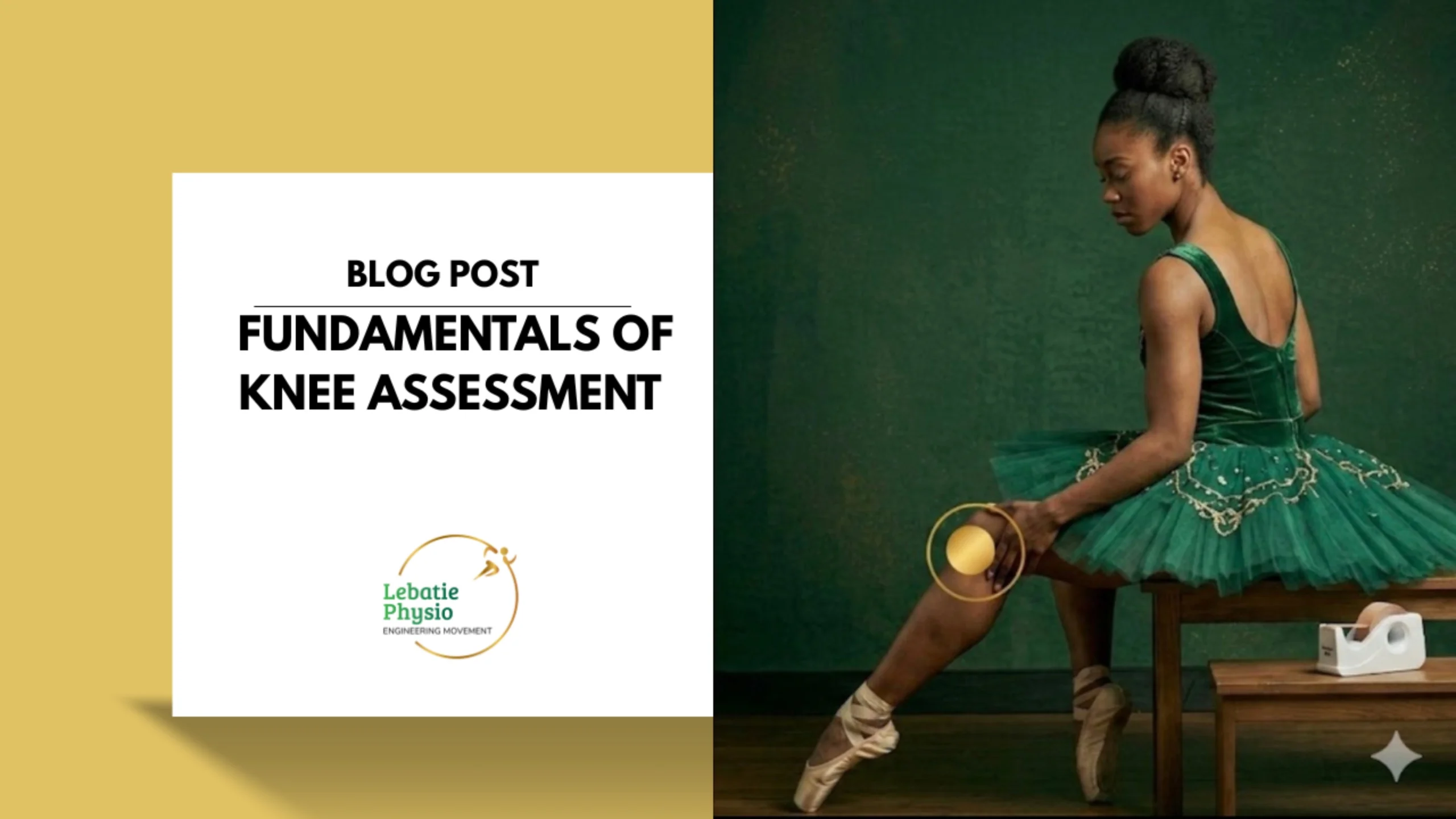
The Clinical Detective Work Behind a Professional Knee Assessment
If your knee has started making weird clicking sounds, feels like it’s going to catch, or throws a tantrum every time you tackle a flight of stairs, you are probably eyeing the clinic door. But if you think a knee check-up is just a random guessing game, think again. Your knee is a highly specialised piece of machinery, and figuring out why it hurts requires a structured, clinical process.
Here is exactly how we analyse a knee for your everyday individual, step-by-step with a special little detour for my fellow dancers out there!
The Investigation Phase (Subjective Assessment)
Before we even look at the joint, we start with a detailed conversation. I’ll want to know the exact mechanism of injury, did you twist it awkwardly, or did it just start aching out of nowhere? We will talk about the type of pain you feel (sharp, dull, throbbing, or burning) and any mechanical symptoms like catching, locking, or swelling. What makes it worse? Is it worse going down stairs or sitting in a car? Your answers build a clinical roadmap, letting me know which structures (like tendons, ligaments, or cartilage) are the prime suspects.
Checking the Neighbours (Hip, Ankle and Nerve Wiring)
Your knee is essentially a middle child stuck between two very bossy joints: the hip and the ankle. It frequently takes the blame for problems caused by its neighbours. Because of this, we always take a moment to clear the joints above and below, making sure your knee pain isn’t just a byproduct of a tight ankle or a weak hip.
We also do a quick neurological check, tapping your knees and ankles to test your reflexes and checking your skin sensations (dermatomes). This ensures that an irritated nerve in your lower back isn’t playing tricks on your leg and masking itself as knee pain.
The Move Screen (Functional Movement Assessment)
Once the nerves are clear, I’ll want to see your body in motion. I’ll ask you to perform a few everyday movements, like a double-leg squat, a single-leg squat, or a balance test.
Don’t worry this isn’t an audition for an Olympic weightlifting team!
I am simply looking at how your knee tracks in real-time. Does it cave inward when you squat? Does your pelvis drop? Seeing how your muscles work together gives us immediate clues about stability issues that might be overloading the joint.
Bending, Straightening, and Local Poking (Special Tests)
After analysing your movement, we get you on the bed to check your true flexibility and structural integrity. I’ll test your Range of Motion actively (what you can do) and passively (what I can push the joint to do when you relax).
Finally, we perform special tests to check the actual hardware. Your knee relies heavily on internal cables (ligaments like the ACL and MCL) and rubbery shock-absorbers (the meniscus). By applying precise, gentle manual pressures to the joint, like shifting the shin bone slightly forward or placing a specific angle of pressure on the knee, we can see if we safely replicate that specific “twinge” or “catch” you’ve been feeling.
The Dancer's Knee Spotlight
Now, because I’m a dancer myself, I absolutely had to add a special section for my performance crowd right before we wrap this up! While everyday squats tell us a lot, dancers place an extraordinary, unique strain on their knees. Between deep plies, jumps, leaps, and repetitive loading, the forces passing through that joint are intense.
When a dancer walks into the clinic, I am looking out for the most common knee pathologies we see in the dance world. One major issue stems from forcing your turnout. If you don’t have enough natural rotation coming from your hips, the body love to sneakily cheat by forcing the feet outward and twisting (screwing) the knee joint under heavy weight.
This mechanical cheating leads directly to the most common dance pathologies: kneecap tracking issues, patellar tendinopathy (jumper’s knee), and meniscus tears from all that forced twisting. If you’re a dancer, my assessment gets highly tailored to look at your specific turnout, jumping mechanics, and landing control to see exactly where your technique might be overloading the joint.
The Verdict
By combining your story, your overall leg mechanics, and the results of those local structural and dance-specific tests, we can form a clear clinical diagnosis. Whether it’s a tracking issue from a forced turnout, an irritated tendon, or a mild ligament sprain, the guesswork is completely over. From here, we map out a personalised rehabilitation plan to balance your muscle chain, line that kneecap back up on its tracks, and get you moving confidently and beautifully again!