What is proximal ITB enthesopathy?
Proximal iliotibial band (ITB) enthesopathy is irritation or degeneration at the point where the ITB attaches to the bone at the iliac tubercle (1).
Where is the pain located?
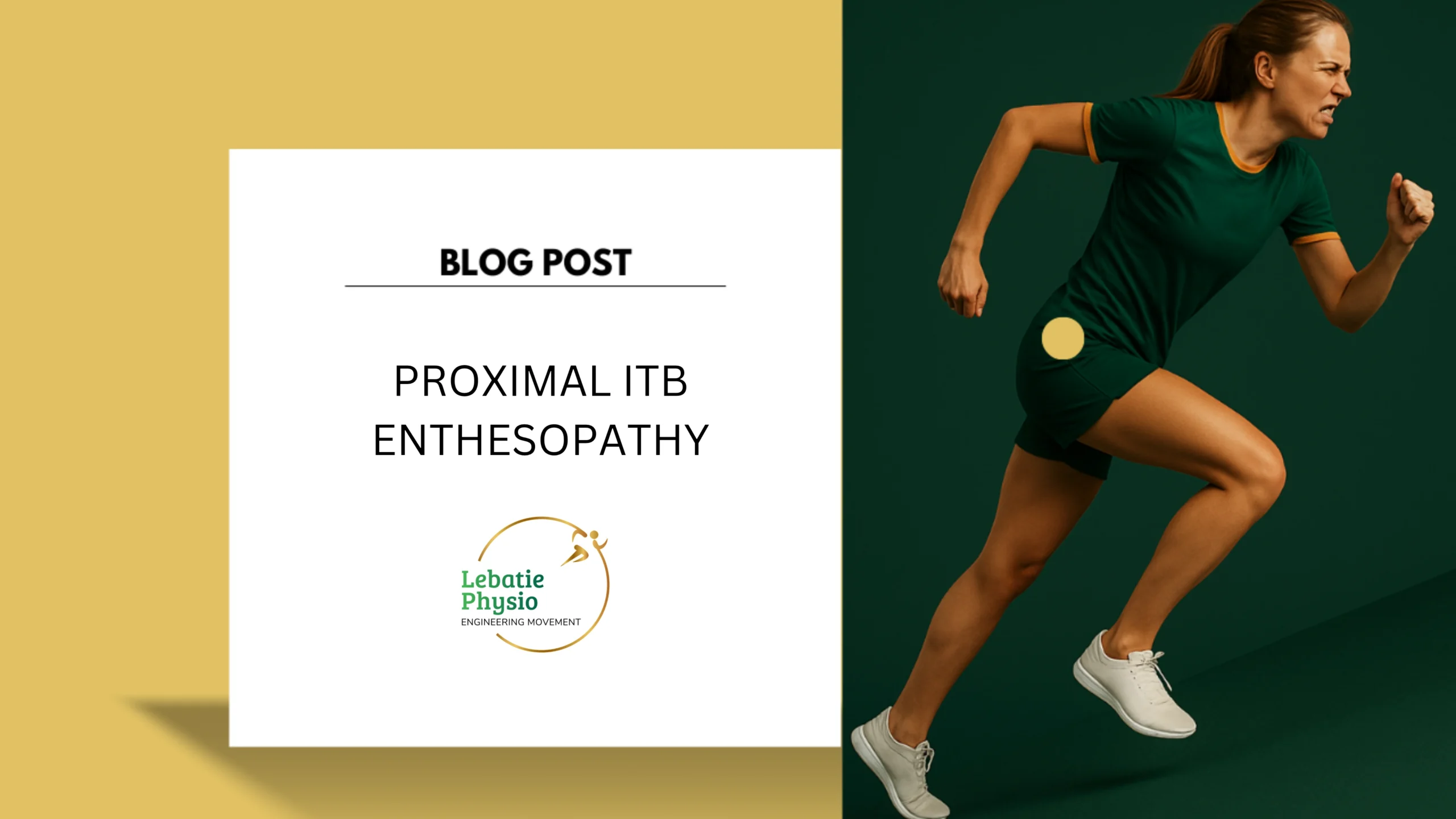
Most people feel a clear, localized ache over the outer upper hip where the ITB connects to the iliac crest of the pelvis (2).
Who does it affect?
It most commonly affects women between 32–67 years old, especially runners and those with a higher BMI (1).
What is the ITB and why is it important?
The ITB is a strong band of tissue that helps stabilize the hip and knee by transferring forces from the Tensor Fascia Lata (TFL) and gluteus maximus (7).
What does the ITB do?
- It helps control the pelvis and prevent hip drop during walking or running (7).
- It supports knee stability by resisting inward forces (7).
- It stores and releases elastic energy during movement, similar to a tendon (7).
Why does the ITB attachment get overloaded?
1. Muscle imbalance
When the primary hip abductors/glutes are weak, the body shifts work to the ITB-tensioning muscles, increasing strain on the ITB attachment (8).
2. Running mechanics
Excessive hip adduction and internal rotation—more common in women—place increased tension on the ITB (2).
3. Running uphill
Running on inclines increases hip adduction and muscle activation, raising ITB load, especially in females (12).
4. Running speed
Faster running increases hip adduction and internal rotation angles in women (12).
5. Fatigue
As runners fatigue, knee rotation increases and twists the ITB, straining the upper attachment (13).
6. Low running cadence
Lower step rates increase peak hip adduction and ITB strain during running (10).
7. Metabolic factors
Metabolic disorders negatively affect tendon and enthesis (the tendon attachment site) health by increasing inflammation and tissue degeneration (15).
How does proximal ITB enthesopathy present?
Symptoms usually develop gradually, with constant pain over the iliac tubercle that may worsen during single-leg stance or running, and some people show a positive Trendelenburg sign (18).
How is it diagnosed?
Diagnosis relies on palpation, strength testing, movement observation, and ruling out other causes of lateral hip pain (20). Ultrasound may show thickening or increased blood flow at the ITB attachment (19). MRI helps rule out other conditions, but it must include the iliac crest region because small hip field-of-view scans often miss the proximal ITB (4).
How is it treated?
1. Pain management
Short-term rest, ice, and anti-inflammatory medication can help reduce symptoms (1).
2. Education
Understanding the effects of cadence, uphill running, postures, and training load is key to reducing aggravation (21).
3. Balance and control training
Improving single-leg stability helps correct excessive hip adduction linked to ITB strain² (22).
4. Running technique changes
Increasing cadence and reducing hip adduction during running can decrease strain on the ITB (21).
5. Avoid stretching the outer hip
Stretching the lateral hip can compress and irritate the enthesis and should be avoided (21).
6. Strengthening the right muscles
Exercises that strengthen the gluteal muscles while reducing TFL overuse – such as clams, sidestepping, and single-leg bridges – are recommended (23).
What is the outlook?
Most individuals improve with correct diagnosis, targeted strengthening, and adjustments to running technique (18).
References:
1. PM R. 2019;11(2):206-209.
2. Skeletal Radiol. 2011;40(12):1553-1556.
3. Semin Arthritis Rheum. 2007;37(2):119-126.
4. Radiographics. 2013;33(5):1437-1452.
5. Muscles Ligaments
Tendons J. 2014;4(3):333-342.
6. BJSM.2020 Lateral ‘hip’ pain? Don’t always blame the glutes
7. Sports Med. 2022;52(5):995-1008.
8. Sports Med. 2015;45(8):1107-1119.
9. Ann Anat. 1993;175(3):203-210.
10. J Sports Sci. 2015;33(7):724-731.
11. J Orthop Sports Phys Ther. 2010;40(2):52-58.
12. Clin Biomech (Bristol). 2008;23(10):1260-1268.
13. Gait Posture. 2007;26(3):407-413.
14. Med Sci Sports Exerc. 2011;43(2):296-302.
15. Reumatol Clin. 2022;18(5):273-278.
16. Clin Rheumatol. 2014;33(10):1517-1522.
17. J Rheumatol. 2020;47(7):968-972.
18. MOJ Orthop Rheumatol 10(1): 00381.
19. JBR-BTR. 2012;95(6):369.
20. Phys Med Rehabil Clin N Am. 2016;27(1):53-77.
21. Sports Med. 2015;45(8):1107-1119.
22. J Orthop Sports Phys Ther. 2015;45(11):910-922.
23. J Orthop Sports Phys Ther. 2013;43(2):54-64.
24. Int J Sports Phys Ther. 2020;15(6):856-881.