The Hidden Role Your Hips Play in Power, Performance and Longevity
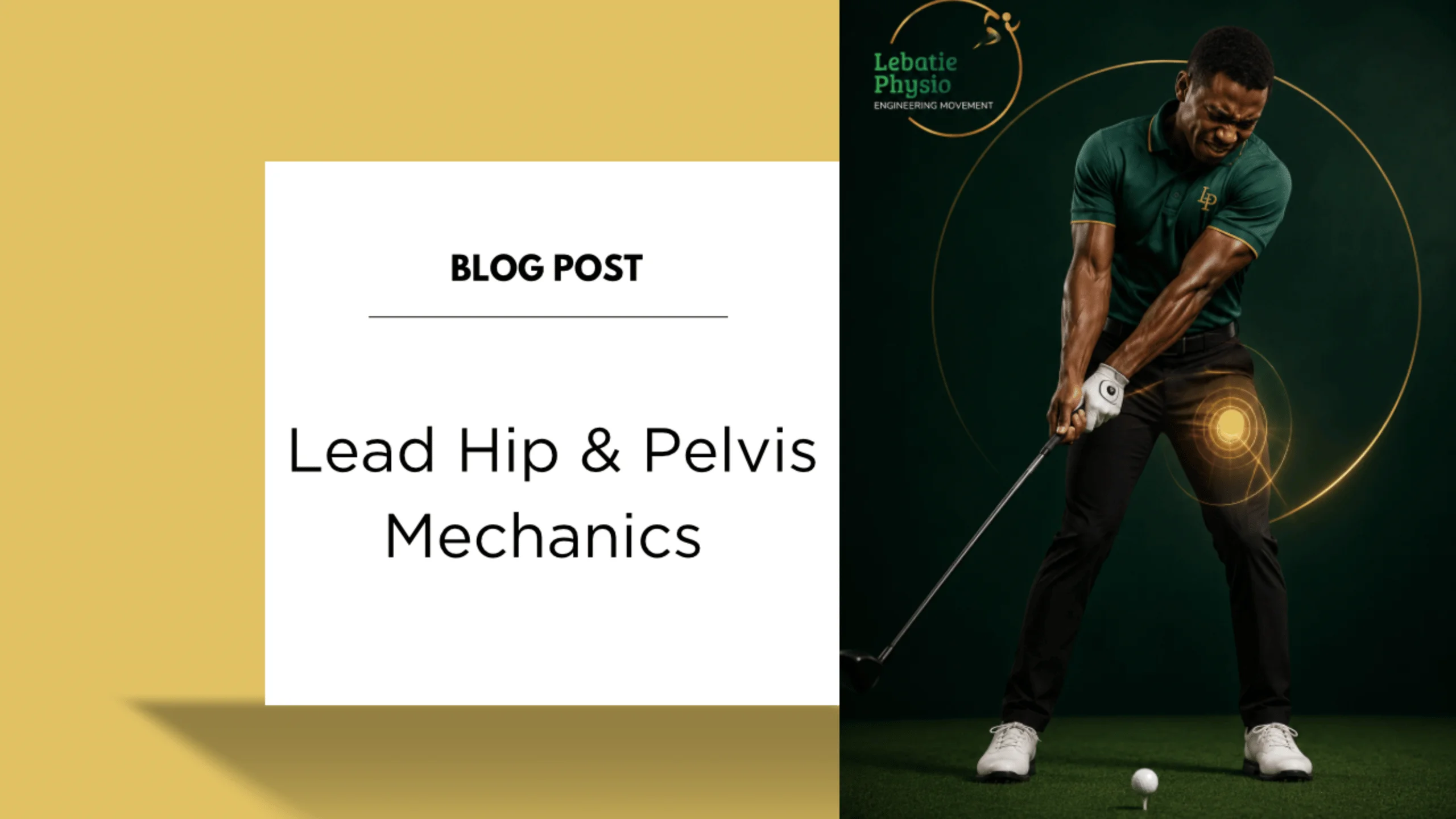
Most golfers spend years trying to improve their swing. They work on their grip. They adjust their stance. They watch countless swing videos. Yet one of the biggest influences on golf performance is often ignored: Your hips. In particular, your lead hip.
Every powerful golf swing relies on the lead hip’s ability to rotate, stay stable and transfer energy through the body. When the hip moves well, generating speed feels easier. When it doesn’t, golfers often notice stiffness, loss of distance, inconsistency, and eventually pain.
At Lebatie Physio, we regularly assess golfers whose swing problems are actually movement problems. Sometimes the fastest way to improve your golf isn’t changing your swing. It’s improving the body that’s producing it.
Why Your Lead Hip Matters So Much
Think about what happens during a golf swing. Your body rotates rapidly toward the target while remaining balanced and controlled. Your lead hip acts as the foundation for that movement.
It helps you:
- Create power
- Rotate efficiently
- Maintain balance
- Transfer energy through the swing
- Finish comfortably
Without good hip function, the rest of the swing often has to compensate. And compensation rarely improves performance.
Why Have I Lost Distance?
One of the most common frustrations golfers experience is a gradual loss of distance. Many assume it’s simply part of getting older. Sometimes it is. But very often, reduced hip mobility plays a major role.
When your lead hip becomes stiff:
- Rotation becomes restricted
- Speed becomes harder to generate
- Power leaks occur throughout the swing
- Other parts of the body work harder to compensate
The result is often a swing that feels more effortful but produces less distance. Not exactly the trade-off most golfers are looking for.
Why Does My Hip Feel Stiff After Golf?
Hip stiffness is incredibly common among golfers. For many players, it develops gradually over months or years.
You may notice:
- Tightness in the groin
- Stiffness after walking 18 holes
- Discomfort during the follow-through
- Difficulty turning through the ball
- Reduced flexibility compared to previous years
These symptoms are often early warning signs that the hip isn’t moving as efficiently as it once did. Ignoring them rarely improves the situation. Human beings remain surprisingly optimistic about this fact.
Can Golf Cause Hip Pain?
Golf itself isn’t usually the problem. The issue is often the thousands of swings performed over many years. Every swing places repeated stress through the lead hip. When the body manages that stress well, there is usually no issue. When movement becomes restricted or inefficient, irritation can gradually develop.
Many golfers report:
- Groin pain
- Pinching in the front of the hip
- Stiffness during rotation
- Discomfort after practice sessions
- Reduced ability to complete the follow-through
These symptoms often develop slowly rather than appearing suddenly.
Can Hip Problems Affect My Back?
Absolutely. The body works as a connected system. If the hip isn’t moving properly, the lower back often attempts to make up the difference.
This is one reason why golfers with persistent back pain frequently also have underlying hip restrictions. The back may be where the pain is felt. The hip may be where the problem started.
Is Hip Arthritis Inevitable?
Not at all. Many golfers worry that stiffness automatically means arthritis is around the corner. The reality is more encouraging. While some age-related changes are normal, maintaining good movement, strength and physical conditioning can help support long-term joint health. Early intervention is particularly important. The sooner movement limitations are identified, the easier they are to address.
What Are the Warning Signs You Shouldn’t Ignore?
Consider seeking professional assessment if you regularly experience:
- Groin pain during or after golf
- Loss of hip mobility
- Difficulty rotating through the ball
- Reduced distance
- Persistent stiffness
- Pain getting in or out of a car
- Difficulty tying your shoes
Symptoms that continue to worsen over time
These signs don’t necessarily indicate serious damage, but they do suggest that your body may need attention.
How We Assess Golfers at Lebatie Physio
At Lebatie Physio, we don’t just look at where you hurt. We look at why.
A golf assessment may include:
- Hip mobility testing
- Movement assessment
- Balance and control testing
- Golf-specific movement analysis
- Strength assessment
Our goal is to identify what may be limiting your performance before it becomes a bigger issue. Because treating symptoms without understanding the cause is a bit like fixing a leaking roof by moving the bucket.
How Physiotherapy Can Help
Many golfers assume physiotherapy is only useful once they’re injured. In reality, physiotherapy can help golfers improve both performance and longevity.
Treatment may focus on:
- Improving hip mobility
- Building strength
- Improving rotational control
- Enhancing balance
- Reducing pain
- Increasing resilience to practice and play
The objective isn’t simply to get you out of pain. It’s to help you continue playing the game you love for as long as possible.
Can Hip Problems Be Prevented?
Nothing in life is guaranteed. Not taxes. Not three-putts. Not finding your ball after confidently announcing, “I saw exactly where it landed.” However, golfers can reduce their risk by:
- Staying physically active
- Maintaining hip mobility
- Strength training regularly
- Managing practice volume sensibly
- Addressing symptoms early
Small investments in movement today often prevent larger problems tomorrow.
Final Thoughts
The lead hip is one of the most important contributors to an efficient golf swing.
It influences:
- Power
- Distance
- Consistency
- Comfort
- Long-term joint health
Many golfers spend years chasing technical fixes when their body may be the real limiting factor. Sometimes the quickest route to better golf isn’t changing your swing. It’s improving the way you move.
At Lebatie Physio, our mission is simple: Engineering Movement. Because when your body moves better, your golf game usually follows.
Ready to Improve Your Golf Performance?
Whether you’re dealing with hip pain, recovering from injury or looking to optimise your golf performance, Lebatie Physio can help. Book a Golf Performance Assessment today.
📍 Waterfall Health Centre, Country Estate Drive, Midrand, 2090
📞 011 027 2111📱 084 816 5457📧 info@floydlebatiephysio.co.za 🌐 www.floydlebatiephysio.co.za
References
Agricola, R., Heijboer, M.P., Bierma-Zeinstra, S.M.A., Verhaar, J.A.N. and Weinans, H. (2013) ‘Cam impingement causes osteoarthritis of the hip: A nationwide prospective cohort study’, Osteoarthritis and Cartilage, 21(7), pp.993-999.
Ball, K. and Best, R. (2007) ‘Different centre of pressure patterns within the golf stroke’, Journal of Sports Sciences, 25(7), pp.757-770.
Beck, M., Kalhor, M., Leunig, M. and Ganz, R. (2005) ‘Hip morphology influences the pattern of damage to the acetabular cartilage: Femoroacetabular impingement as a cause of early osteoarthritis of the hip’, Journal of Bone and Joint Surgery (British Volume), 87-B(7), pp.1012-1018.
Cheetham, P.J., Martin, P.E., Mottram, R.E. and St Laurent, B.F. (2001) ‘The importance of stretching the X-factor in the downswing of golf: The X-factor stretch’, Optimising Performance in Golf, pp.192-199.
Dickenson, E., Ahmed, I., Fernandez, M., Ross, J., Harris-Hayes, M. and Lewis, C. (2016) ‘Hip morphology and range of motion in elite golfers’, Sports Health, 8(3), pp.247-254.
Frank, J.M., Harris, J.D., Erickson, B.J., Slikker, W., Bush-Joseph, C.A., Salata, M.J., Nho, S.J. and McCormick, F.M. (2015) ‘Prevalence of femoroacetabular impingement imaging findings in asymptomatic volunteers’, Arthroscopy, 31(6), pp.1199-1204.
Ganz, R., Parvizi, J., Beck, M., Leunig, M., Nötzli, H. and Siebenrock, K.A. (2003) ‘Femoroacetabular impingement: A cause for osteoarthritis of the hip’, Clinical Orthopaedics and Related Research, 417, pp.112-120.
Griffin, D.R., Dickenson, E.J., O’Donnell, J., Agricola, R., Awan, T., Beck, M., Clohisy, J.C., Dijkstra, H.P., Falvey, E., Gimpel, M. and Hinman, R.S. (2018) ‘The Warwick Agreement on femoroacetabular impingement syndrome (FAI syndrome): An international consensus statement’, British Journal of Sports Medicine, 50(19), pp.1169-1176.
Kwon, Y.H., Como, C.S., Singhal, K., Lee, S. and Han, K.H. (2013) ‘Assessment of pelvis and thorax motion during the golf swing’, Journal of Sports Sciences, 31(11), pp.1186-1196.
Lindsay, D.M. and Horton, J.F. (2002) ‘Comparison of spine motion in elite golfers with and without low back pain’, Journal of Sports Sciences, 20(8), pp.599-605.
McHardy, A., Pollard, H. and Luo, K. (2006) ‘Golf injuries: A review of the literature’, Sports Medicine, 36(2), pp.171-187.
Menge, T.J., Briggs, K.K., Dornan, G.J. and Philippon, M.J. (2017) ‘Outcomes following hip arthroscopy for femoroacetabular impingement in golfers’, Arthroscopy, 33(7), pp.1257-1265.
Newman, J.T., Briggs, K.K., McNamara, S.C. and Philippon, M.J. (2016) ‘Hip disorders in golfers’, Current Reviews in Musculoskeletal Medicine, 9(1), pp.26-34.
Nötzli, H.P., Wyss, T.F., Stoecklin, C.H., Schmid, M.R., Treiber, K. and Hodler, J. (2002) ‘The contour of the femoral head-neck junction as a predictor for the risk of anterior impingement’, Journal of Bone and Joint Surgery (British Volume), 84-B(4), pp.556-560.
Philippon, M.J., Maxwell, R.B., Johnston, T.L., Schenker, M. and Briggs, K.K. (2007) ‘Clinical presentation of femoroacetabular impingement’, Knee Surgery, Sports Traumatology, Arthroscopy, 15(8), pp.1041-1047.
Reiman, M.P., Goode, A.P., Hegedus, E.J., Cook, C.E., Wright, A.A. and Croy, T. (2015) ‘Diagnostic accuracy of clinical tests for the diagnosis of hip femoroacetabular impingement/labral tear’, British Journal of Sports Medicine, 49(12), pp.811-822.
Seldes, R.M., Tan, V., Hunt, J., Katz, M., Winiarsky, R. and Fitzgerald, R.H. (2001) ‘Anatomy, histologic features and vascularity of the adult acetabular labrum’, Clinical Orthopaedics and Related Research, 382, pp.232-240.
Tannast, M., Kubiak-Langer, M., Langlotz, F., Puls, M., Murphy, S.B. and Siebenrock, K.A. (2007) ‘Noninvasive three-dimensional assessment of femoroacetabular impingement’, Journal of Orthopaedic Research, 25(1), pp.122-131.
Waterman, B.R., Rensing, N., Cameron, K.L., Owens, B.D. and Pallis, M.P. (2018) ‘Return to sport following hip arthroscopy for femoroacetabular impingement’, American Journal of Sports Medicine, 46(7), pp.1661-1668.