The Overlooked Link Between Your Neck, Vision and Golf Performance
Most golfers spend their time chasing better swing mechanics, more distance, and improved consistency. They work on mobility. They buy new clubs. They watch instructional videos.
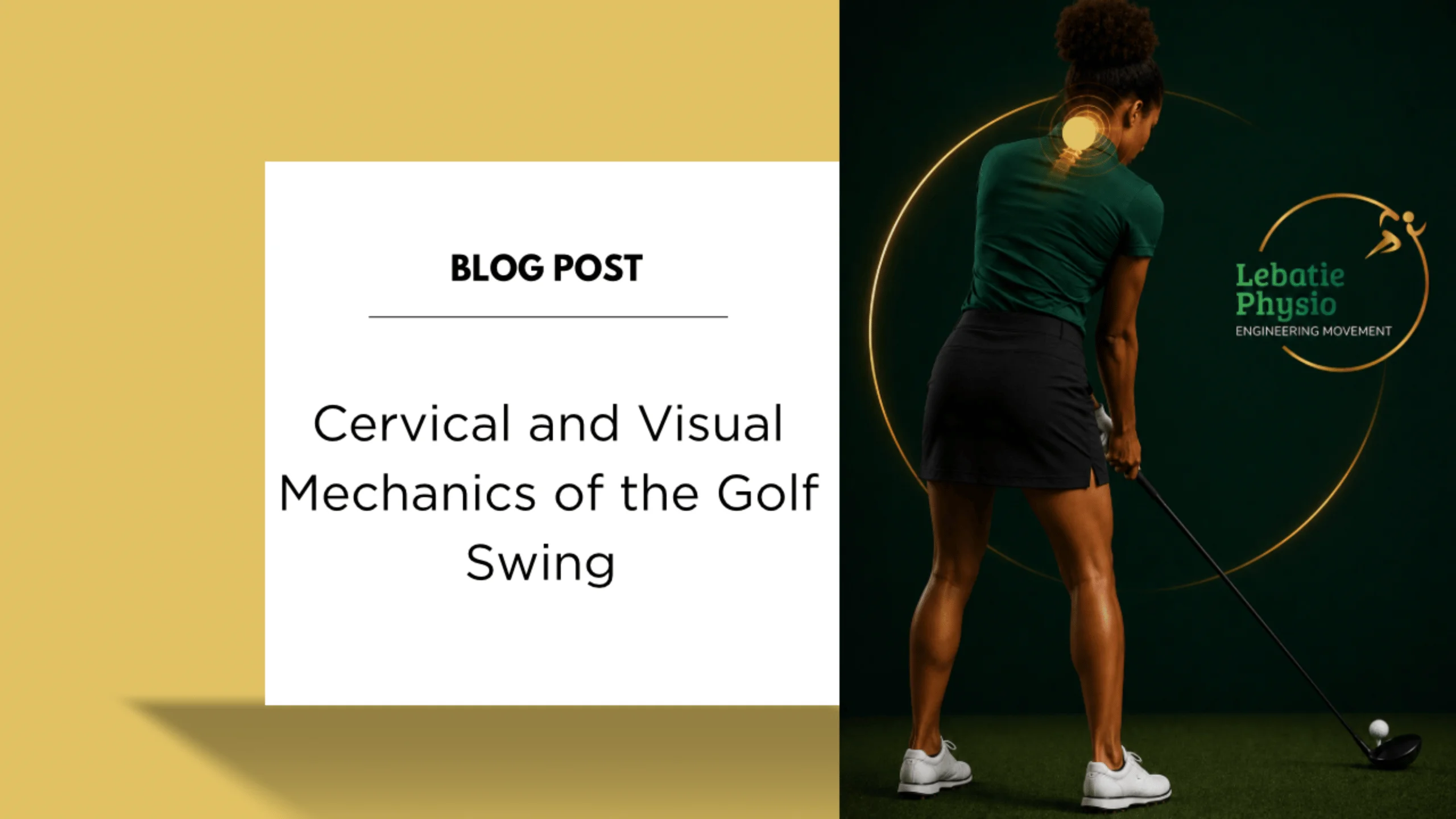
Yet very few golfers ever consider one body part that quietly influences almost every shot they hit: Their neck. It sounds strange at first. After all, your neck isn’t holding the club. But your neck plays a major role in helping you maintain balance, focus on the ball, judge distances, and control movement throughout your swing.
In many cases, neck stiffness, poor posture, or reduced movement can quietly affect performance long before golfers realise it. Let’s take a closer look.
Why Your Neck Matters More Than You Think
Think about everything that needs to happen during a golf swing.
You need to:
- Keep your eyes focused on the ball
- Stay balanced
- Control your head position
- Rotate effectively
- Judge distance and direction
- Execute a precise movement under pressure
Your neck helps coordinate all of these tasks. It constantly communicates with your eyes and brain to help you understand where your body is in space. When everything works well, movement feels natural. When it doesn’t, golfers often experience stiffness, inconsistency, balance problems, reduced focus, or recurring pain.
Can Neck Stiffness Affect Your Golf Swing?
Absolutely. A lack of neck mobility can make it difficult to maintain good posture and head control throughout the swing. Many golfers compensate without realising it.
You may notice:
- Excessive head movement
- Difficulty completing your backswing comfortably
- Loss of balance
- Inconsistent ball striking
- Neck tightness after playing
The body is excellent at finding alternative ways to move. Unfortunately, those alternatives aren’t always efficient. One restriction often creates another problem somewhere else.
Why Do Some Golfers Struggle to Keep Their Head Still?
“Keep your head down.” It’s one of the oldest pieces of golf advice ever given. Yet keeping your head stable isn’t simply a matter of discipline. It depends on how well your body can control your posture and movement.
If your neck is stiff or fatigued, maintaining a steady head position becomes more challenging. This can influence ball contact, consistency, and overall swing control. A stable head often creates a stable swing.
Can Your Vision Affect Your Golf Performance?
Far more than most golfers realise. Golf is a visual sport. Every shot requires you to:
- Judge distance
- Pick a target
- Read slopes and greens
- Track the ball
- Maintain focus under pressure
The best golfers aren’t necessarily seeing better. They’re often processing visual information more effectively. Small improvements in focus and visual control can make a noticeable difference, particularly around the greens.
Why Putting Is More About Your Eyes Than You Think
Putting may be the most visually demanding skill in golf. Before every putt, your brain is gathering information about:
- Distance
- Speed
- Direction
- Green contours
- Alignment
Research shows that skilled golfers tend to keep their focus steadier before and during a putt. They appear calmer. Less rushed. More controlled. This doesn’t happen by accident. Their ability to focus on the right information helps them execute more consistently under pressure.
Can Neck Pain Affect Concentration and Focus?
Many golfers are surprised to learn that neck pain doesn’t just affect comfort. It can also affect concentration. When the body is dealing with discomfort, maintaining focus becomes harder.
Some golfers with ongoing neck problems report:
- Difficulty concentrating
- Feeling mentally fatigued
- Reduced confidence
- Trouble maintaining focus during a round
If you’ve ever felt mentally exhausted after a round despite not walking particularly far, your body may be working harder than you realise.
Why Good Posture Still Matters
Posture isn’t about standing like a mannequin. It’s about putting your body in the best position to move efficiently.
Poor posture can influence:
- Balance
- Head position
- Visual focus
- Comfort during a round
- Swing consistency
Golfers who spend long hours at desks often arrive at the course already carrying stiffness and tension into their swing. Improving posture isn’t about perfection. It’s about creating a better starting point.
How We Assess Golfers at Lebatie Physio
At Lebatie Physio, we don’t just look at the golf swing. We look at the golfer.
Our assessments may include:
- Neck mobility
- Balance
- Movement control
- Visual tracking
- Posture
- Golf-specific movement patterns
The goal is simple: Identify what may be limiting your performance before it becomes a bigger problem. Because guessing is rarely a successful performance strategy.
How Physiotherapy Can Help Your Golf Game
Many golfers only consider physiotherapy when they’re injured. In reality, physiotherapy can also help golfers improve performance.
Treatment may focus on:
- Improving neck mobility
- Enhancing posture
- Improving balance
- Building movement control
- Reducing pain and stiffness
- Helping golfers move more efficiently
Better movement often leads to better golf. It’s a surprisingly effective strategy.
Final Thoughts
Most golfers focus on their hands, arms and swing technique. Few think about their neck. Yet your neck plays an important role in balance, focus, movement control and visual performance throughout every round. Sometimes the difference between a great shot and a frustrating one isn’t found in your driver, your putter, or your latest swing thought. Sometimes it’s found in how well your body is working behind the scenes.
At Lebatie Physio, our mission is simple: Engineering Movement. Because when your body moves better, your golf game often follows.
Ready to Optimise Your Golf Performance?
Whether you’re experiencing neck pain, dizziness, visual difficulties, post-concussion symptoms or simply looking to improve your golf performance, our team can help. Book a Golf Performance Assessment with Lebatie Physio today.
📍 Waterfall Health Centre, Country Estate Drive, Midrand, 2090
📞 011 027 2111📱 084 816 5457📧 info@floydlebatiephysio.co.za 🌐 www.floydlebatiephysio.co.za
References
Alizadeh, M., Knapik, G.G., Marras, W.S. and Santhosh, J. (2020) ‘Biomechanical musculoskeletal models of the cervical spine: A systematic literature review’, Clinical Biomechanics, 79, p.104876.
Angelaki, D.E. and Hess, B.J.M. (2000) ‘Direction of heading and vestibular signals during passive whole-body rotation’, Journal of Neuroscience, 20(1), pp.1-10.
Bogduk, N. and Mercer, S. (2000) ‘Biomechanics of the cervical spine. I: Normal kinematics’, Clinical Biomechanics, 15(9), pp.633-648.
Bourgain, M., Wang, W., Lamberts, R.P. and Coetzee, J.C. (2022) ‘Golf swing biomechanics: A systematic review and methodological recommendations’, Sports, 10(6), p.91.
Buttner, U. and Buettner-Ennever, J.A. (1996) ‘Cerebellar and brainstem control of eye movements’, Journal of Neurophysiology, 75(2), pp.561-570.
Moore, L.J., Vine, S.J., Cooke, A. and Wilson, M.R. (2012) ‘Quiet eye training expedites motor learning and aids performance under heightened anxiety: The roles of response programming and external attention’, Psychophysiology, 49(7), pp.1005-1015.
Nesbit, S.M. and Serrano, M. (2005) ‘Work and power analysis of the golf swing’, Journal of Sports Science and Medicine, 4(4), pp.520-533.
Pettorossi, V.E. and Schieppati, M. (2014) ‘Neck proprioception shapes body orientation and perception of motion’, Journal of Neurophysiology, 111(2), pp.248-258.
Revel, M., Andre-Deshays, C. and Minguet, M. (1994) ‘Cervicocephalic kinaesthetic sensibility in patients with cervical pain’, Archives of Physical Medicine and Rehabilitation, 75(8), pp.895-899.
Swartz, E.E., Floyd, R.T. and Cendoma, M. (2005) ‘Cervical spine functional anatomy and the biomechanics of cervical spine injury’, Journal of Athletic Training, 40(3), pp.198-205.
Treleaven, J., Jull, G. and Sterling, M. (2006) ‘Dizziness and unsteadiness following whiplash injury: Characteristic features and relationship with cervical joint position error’, Clinical Journal of Pain, 22(2), pp.170-176.
Vickers, J.N. (2007) Perception, Cognition and Decision Training: The Quiet Eye in Action. Champaign, IL: Human Kinetics.